
You’ve submitted your resume, and then you get the call. It’s exciting to be contacted by the hiring manager, knowing they are interested in your skills and experience.
Now you just have to make a good impression during your interview.
The thought is enough to get any candidate’s heart racing. Luckily, there is a way to ensure that you head to your interview with confidence: preparation.
Preparing yourself for a job interview is crucial for getting through to the next stage of the job application process.
Certain common questions can stump job seekers or catch them off guard. To prevent this, you can prepare for the most common interview questions and do plenty of research on the company, its culture, and the type of job before the interview.
Mastering Interview Questions with Confidence
While you don’t need to follow a script, practice makes perfect. If you go over some examples of answers to interview questions and then think about your answers, you’ll be able to respond confidently on the spot.
Below, we’ll highlight some of the best strategies for interview preparation, dive into common interview questions, and even provide tailored advice for select industries.
But you may be wondering, why does preparing structured answers matter so much? Today’s job market is competitive. To land the job you want, you need to exude confidence and package your skills and accomplishments in a way that “sells.”
Winging it in the moment likely won’t do this for you, but thoughtfully considering your answers in advance will.
Essential Strategies for Answering Interview Questions Effectively
The following strategies for answering interview questions can make it easy to say all the right things:
- Don’t rush your answer: You don’t need to start answering the second the interviewer has finished asking the question. Consider the question and remain calm as you gather your thoughts.
- Use examples to demonstrate your points: One of the biggest mistakes job seekers make is that they don’t back up their answers with examples. It’s not enough to say you’re well-organized, for example, what can you mention to prove it? You can use the STAR method (Situation, Task, Action, and Result) to frame relevant experiences.
- Tailor your answers: Some parts of your past experiences will be more relevant than others to the job you’re seeking. For example, operating kitchen equipment in a restaurant isn’t relevant to a retail position, but handling customer complaints is. Familiarize yourself with the needs of the new job, and match these to your strengths.
- Understand employer intent: Some open-ended questions, like “Tell me about a time you failed,” may make you feel uncomfortable or defensive. But understanding what the employer is trying to get at can help you answer in a way that allows them to learn about you. For this example, you might discuss how you took ownership, solved problems, and what you learned. This will keep you focused and positive.
- Don’t take too long: The ideal time for answering a question is 2 minutes. Of course, you won’t have a stopwatch, and you don’t need to rush. Just keep your answers brief and to the point.
Common Interview Questions and How to Answer Them
There are a few categories of questions that interviewers love to ask candidates. We’ll look at them one at a time, analyze why the interviewer might ask them, and give you example answers.
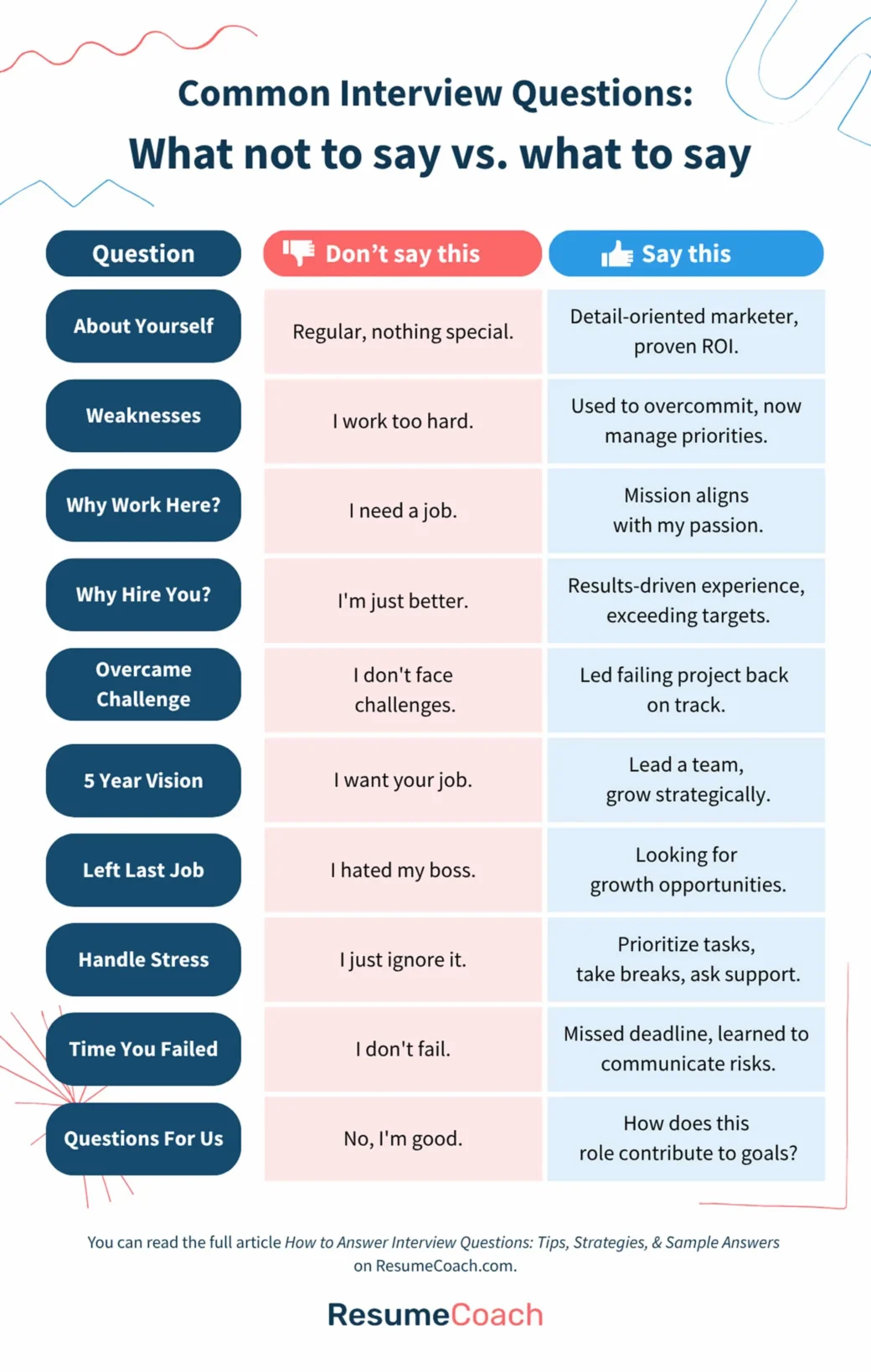
Basic interview questions
Basic interview questions often cover general information about you, your strengths and weaknesses, and what made you interested in the company.
The hiring manager wants to know what you can bring to the table and if you are motivated to work for them.
Why are you interested in this company?
Employers ask this question to determine if you are genuinely excited about working for them, or if you’re just seeking any job. They also want to know if you’ve done your research to understand the company’s values, mission, and culture. This helps them determine if you would be a good long-term fit for their team.
Sample answer: I’m impressed with your company’s commitment to innovation and its clear vision for the future. The culture of continuous learning and collaboration also appeals to me. I believe that working here would offer valuable opportunities for professional growth, and I’m excited about the prospect of contributing to your ongoing success.
Why should we hire you?
This question is all about what value you bring to the table and what sets you apart from other candidates. What is unique about you? Can you clearly articulate your skills and how they match the role, confidently, with self-awareness, but without being arrogant?
Sample answer: I believe I am the right fit for this position because of my relevant education, hands-on experience in [specific areas], and passion for [industry or company mission]. My ability to quickly adapt, learn new skills, and work well with others will enable me to contribute effectively to your team’s success from day one. I’m eager to make a positive impact and help your organization achieve its goals.
What are your strengths and weaknesses?
This helps the employer determine if you are honest and if your strengths align well with the role. It also helps them see how you see yourself–can you own your challenges while showing a willingness to grow?
Sample answer: One of my key strengths is my adaptability. I thrive in changing environments and can adjust my strategies quickly to meet new challenges. As for weaknesses, I sometimes overanalyze situations. To address this, I have been working on making confident decisions based on available information and then revisiting these decisions as new data becomes available.
Next, we’ll consider the do’s and don’ts of discussing salary.
Salary expectation questions
The amount you want to make or expect to make is usually another topic that will be discussed during your interview.
While there is a limit to asking specific questions regarding salary, depending on your state, you should be prepared for anything . You must avoid making any inappropriate demands while still providing insightful answers. Let’s see how.
What salary are you expecting?
Your employer wants to see if your expectations align with the budget for this role. They also want to know if you are well-informed about your market value–do you devalue or overvalue your work? Finally, they want to know if you are flexible or if salary will be a potential deal-breaker.
Sample answer: Based on my research, skills, and experience, I’m seeking a salary between [Appropriate salary range]. I’m open to discussion and also interested in the overall compensation package, including benefits and perks, to make a well-rounded decision.
How important is salary compared to other benefits?
This question is also rooted in your motivation–are you motivated by money, flexibility, growth, the company mission, or something else? Candidates are seen as well-rounded when they’re in it for more than just the paycheck. Finally, it helps them decide whether they can offer a competitive total compensation package.
Sample answer: While salary is significant, it’s not the only factor I consider. I value a comprehensive benefits package and opportunities for work-life balance. A positive work environment and growth potential are also important to me.
How flexible are your salary expectations?
This question ultimately means, are you open to negotiations, or will you walk if we don’t meet your demands? When employers know you are flexible, they may be able to craft a package that makes some trade-offs but benefits you through mission alignment, role fit, and additional benefits.
Sample answer: I’m flexible to an extent, and I understand that a compensation package includes other benefits beyond base salary, like healthcare, retirement contributions, and professional development opportunities. My priority is finding a role that is a good fit and where I can make a meaningful impact.
The important thing, in either case, is being honest and explaining what you think your salary should be and why.
Career goals and development questions
How you see yourself improving as an employee in any field is one of the most common interview questions and answers.
You’ll need to be 100% ready to answer any questions related to your goals and long-term career plans.
Not only will having the correct answer show that you are motivated to do well at a company and become a better employee, but it also tells your employer that you have a clear idea of how to improve.
What goals do you have for yourself?
This question reveals qualities like ambition, direction, and self-motivation. It also ensures that your goals are aligned with what the company can offer.
Sample answer: Professionally, I aim to continually grow in my role, take on increased responsibilities, and ultimately contribute to the company’s strategic direction. On a personal level, my goal is to maintain a healthy work-life balance and continue learning new skills that can enrich my life and career.
How do you plan to achieve your goals?
This question centers on how proactive and strategic you are in planning your career, qualities that could serve you well in your new role.
Sample answer: My plan involves continuous learning, seeking out challenges, and taking on increased responsibility over time. I intend to collaborate closely with my team and mentors to acquire new skills and insights that will assist me in reaching my career goals.
Where do you see yourself in 5 years?
Maybe you last heard this question in a high school or university English class. It’s a valid point. The employer wants someone who will stay and grow with the company.
Again, it touches on goal compatibility, but it can also open the door to conversations on how the company can support your goals, for example, through leadership opportunities or specialization.
Sample answer: I see myself evolving into a position of leadership or expertise within this field. I aim to contribute significantly to strategic decisions and project implementations, based on the skills and experiences I have gained.
What steps have you taken for professional development?
This question lets your employer know whether you’re committed to improving your skills and staying current in your field. It also speaks to your initiative and whether you see growth as your responsibility or someone else’s.
Sample answer: I have actively pursued opportunities for professional development in my current role. This includes attending industry conferences, undergoing relevant training programs, and seeking regular feedback from my superiors and colleagues to understand areas of improvement.
When answering goal and development questions, inform the hiring manager that you are aware of your areas for improvement and are open to feedback and new challenges.
Onboarding and early contribution questions
Recruiters will likely ask you some typical questions about how you intend to establish yourself as a helpful coworker.
The first 8 weeks at any new job are a challenge. Make sure you have considered this often forgotten topic before your interview, so you are not nervous.
How will you establish yourself with your team?
Your employer wants to see if you can quickly build trust and relationships, collaborate, and respect the existing team dynamics. In other words, will you fit in and add value without disrupting the team?
Sample answer: I believe in leading with empathy and understanding. I plan to establish myself by listening first to my teammates, understanding their work styles, and learning from their experiences. I’ll also make sure to share my expertise and ideas collaboratively.
What is your plan for your first month?
This question determines whether you’re coming in with a proactive mindset. There’s often a learning curve when you start a new role–can you balance it with early contributions? Do you expect to be able to get up to speed easily in a new environment?
Sample answer: In my first month, I plan to familiarize myself with the company culture, goals, and team dynamics, while setting up regular check-ins with my manager to ensure alignment. I will also prioritize building relationships with key stakeholders, identifying critical projects, and establishing a 90-day action plan to contribute effectively and drive early success.
When will you begin contributing significantly?
This question pertains to your expectations for the onboarding process. Whether you feel like you’re ready to jump right in or expect to need on-the-job training, your answer should be confident without overpromising.
Sample answer: While the timing largely depends on the complexity of the role and the project, I’m typically able to start contributing within the first few weeks. I have a track record of quickly adapting to new environments and learning about different domains, which should enable me to become effective promptly.
What is your 90-day strategy?
Your potential new boss wants to know if you’re able to think long-term while getting into the action in the short term. Are you methodical or haphazard when it comes to setting goals and executing them?
Sample answer: My strategy for the first 30 days would be to focus on learning about and understanding the company, my team, and the work we’re doing. In the next 30 days, I’d start contributing in small but meaningful ways based on my understanding. Over the last 30 days, I plan to be fully engaged in the work, contributing at a higher level and potentially leading new initiatives based on the insights I’ve gained.
Personal and situational questions
Don’t be surprised if an employer wants to know a bit more about you. They may ask about what you like to do or if you’re a sociable person. You’ll probably be asked about how well you can take criticism and what type of personality you have.
Depending on your answers, you may or may not be seen as a good fit within the company’s culture.
Just as you should be honest about any gaps in your work history, be honest when you answer these types of questions.
How do you stay organized?
In asking this, your employer wants to assess your reliability and attention to detail. They can also judge whether you’ll be able to juggle multiple responsibilities in a fast-paced environment.
Sample answer: I leverage technology tools like project management software, AI tools, and digital calendars to stay organized. I also believe in the power of lists – having a clear, written set of tasks helps me manage my time effectively. Regular reviews of my tasks and priorities ensure I’m focused on the most important things.
How would your friends describe you?
This question examines your self-awareness–how you perceive your personality and interpersonal skills. It also helps determine if you’re a good cultural fit for the team.
Sample answer: My friends would likely describe me as reliable, motivated, and compassionate. I’m someone they can count on when they need help, and I constantly strive to better myself while being empathetic to the needs and feelings of those around me. They might also mention my sense of humor, as I believe laughter is vital to maintaining positive relationships and outlooks in life.
Describe a major challenge and how you handled it.
Your answer will demonstrate whether you can remain calm under pressure, employ critical thinking to solve problems effectively, adapt to changing circumstances, and take responsibility for your actions, regardless of the outcome.
Sample answer: A few years ago, I was part of a project team that encountered significant roadblocks due to sudden regulatory changes. I took the initiative to understand the new regulations, gather information, and propose a new project approach. We restructured our plans, and despite the challenges, we delivered the project successfully.
What is your ideal work environment?
This question reveals whether you’ll thrive or struggle in the company’s structure and culture. Aligning your preferences is good, but proving past performance in similar environments is better.
Sample answer: My ideal work environment is a collaborative and supportive space that fosters innovation and creativity. I thrive in an atmosphere where open communication and continuous learning are encouraged.
How do you handle feedback and criticism?
This question is about whether or not you’re coachable. If you can’t process constructive feedback without becoming defensive, it’s a red flag. Instead, show that you’re open to growth in a healthy, continuous improvement culture.
Sample answer: I view feedback and criticism as essential tools for personal and professional growth. I actively seek constructive feedback and use it to improve my performance. While it can be challenging to hear criticism, I strive to approach it with an open mind and see it as an opportunity for improvement.
By staying brief, confident, and honest, you can answer the most common questions in any job interview without breaking a sweat. With enough preparation, you’ll easily remember every key point that you should touch on.
Bonus Industry-Specific Interview Advice
In addition to the above, which will help you ace any interview questions and answers, we’ve provided some additional suggestions for professionals in specific industries.
Interview tips for tech professionals
- Focus on problem-solving, adaptability, and technical depth.
- Be prepared to explain your decision-making process when solving coding or system issues; think out loud during technical interviews or skills assessments.
- Emphasize collaboration, as tech is rarely a solo endeavor.
- Showcase your learning mindset by sharing how you stay current through certifications, side projects, or GitHub contributions.
- Use the STAR method to highlight how you overcame bugs, managed tight deadlines, or implemented new tools, especially when your solution improved performance or scalability.
Interview tips for healthcare professionals
- Focus on compassion, precision, and patient care under pressure.
- Share stories that show empathy, communication with patients and their families, and teamwork with staff.
- Be ready to describe how you handle emotionally charged or ethically complex situations.
- Highlight regulatory awareness, such as HIPAA or patient safety protocols.
- When discussing challenges, focus on how your actions ensured patient well-being, reduced risk, or improved outcomes.
Interview tips for finance professionals
- Focus on integrity, analytical thinking, and risk management.
- Expect questions about ethical decision-making, handling sensitive data, and problem-solving under pressure.
- Quantify your impact whenever possible–for example, cite cost savings, portfolio growth, or reduced risk.
- Demonstrate your awareness of compliance standards and market trends.
- Frame answers around accuracy, foresight, and how you manage financial responsibility.
Interview tips for creatives
- Focus on innovation, storytelling, and collaboration.
- Be ready to explain your creative process and how you handle feedback or creative blocks.
- Bring a portfolio or discuss specific projects—what was your role, what problem did you solve, and what impact did it have?
- Show versatility, the ability to follow a brief, and bring original ideas.
- Frame stories that highlight creativity, adaptability, and collaboration across functions such as design, marketing, and writing.
Interview Practice Tools
Practicing for your interview can boost your confidence and dramatically improve your performance. You can use free platforms like Google Interview Warmup to rehearse your answers to common interview questions. You’ll receive instant artificial intelligence (AI) feedback to help you improve.
Big Interview allows you to take mock interviews categorized by industry and experience level. It’s a paid service, but often made available for free through libraries or universities.
If you prefer real-time, peer-to-peer practice, check out Pramp. You can participate in live video interviews with other users.
Don’t forget that you’ll need a polished resume to get you to the interview stage. Take advantage of online resume-building and review tools to make this process easy.
FAQs
Still have questions about interview questions? We have the answers.
Yes—but with customization. You can reuse strong examples (especially for common questions like “Tell me about yourself” or “Describe a challenge you overcame”), but make sure you tailor your response to the specific company, role, and values. Reusing the same story is fine as long as you adjust the details to fit the interview context and the employer’s needs.
Aim for 1 to 2 minutes per answer. That’s long enough to tell a clear, impactful story—especially using the STAR method—without overwhelming the interviewer. Avoid rambling, and focus on relevant details that show how your actions led to positive results.
No—don’t memorize word-for-word. Instead, outline key talking points and practice delivering them naturally. Memorized answers can sound stiff or rehearsed, while practiced but flexible responses allow you to stay conversational, confident, and adaptable to follow-up questions.
Struggling with Resume Writing?
Ease the process with our templates
Related Blogs